 INTRODUCTION
This is the story of a team of radio amateurs who love exploring the world around them. It began initially back in 2017 when Grant VK5GR first became interested in activating islands on the air as part of the IOTA program around South Australia. At that stage, having just activated Kangaroo Island (IOTA: OC-139), the question being asked was “where to go next”. Planning commenced to try to visit Flinders Island, located in the Great Australian Bight, off the west coast of Eyre Peninsula, South Australia. Unfortunately, things didn’t progress far, as the only easy way to the island was by charter flight. The costs quickly became a factor, and the project was then shelved.
 Fast forward to November 2023. As the interest in Flinders Island remained, Grant once more looked at how to get there and was surprised to see it was now in reachable by sea, with a new barge operating to the island. In addition, a new expedition team had also emerged in South Australia comprising Paul VK5PAS, Ivan VK5HS, Andy VK5LA, Chris VK5FR and Adam VK5GA/VK2YK, who completed their first expedition to Troubridge Island (as VK5TIL) back in February 2023. It was the perfect opportunity to see if they would like to join in the project to Flinders Island in 2024. Their response was a resounding ‘yes’ and so the VK5FIL 2024 project team was born!
The project set its main goals as:
- Have Fun!
- Participate in the IOTA Program to activate OC-261 (only 32% of IOTA hunters had ever logged that island group, with the last activation being undertaken by Craig VK5CE in 2013)
- Participate in the WWFF Program to activate VKFF-0175 (Flinders Island Important Bird Area), VKFF-1717 (Investigator Group Marine Park) and VKFF-4307 (Heritage Agreement area HA.103) (None of these parks had been activated previously).
The team then agreed to head out to the island for 7 nights and operate multiple HF, VHF, UHF and satellite stations.
WHERE IS FLINDERS ISLAND (IOTA OC-261)?


Initially when the project was announced, many people were confused by where we were going. Many Australians know of Flinders Island in Bass Strait (part of IOTA: OC-195), and immediately assumed that’s where we were heading. Most didn’t realise there are in fact three islands with the same name, and that the island we were headed was located ~30km offshore from the sleepy fishing village of Elliston, on the west coast of the Eyre Peninsula in South Australia. The island itself is ~6000Ha or ~7 x 14 km in size and today has a population of 2 people.

This Flinders Island was in fact first discovered in 1802 by Captain Matthew Flinders (who was the first to make detailed charts of much of South Australia’s coastline). Prior to then it was uninhabited. In 1826, a sealing and later a whaling station were established, which by the 1860s had expanded and moved to become a pastoral property used to raise merino wool. This was quite lucrative, as at the time, the amount of coastal shipping made it easy to deliver goods to market. That very shipping also resulted in numerous shipwrecks, one of which was credited with introducing rats and mice to the island. The island, since then has passed through several hands up to the 1970s, before Peter Woolford’s family took up the lease. These days, however, it has become much more difficult to ship goods back to the mainland. The decision has now been made to move away from growing wool and instead establish the island as a wildlife sanctuary, after a planned destocking and vermin eradication project being planned with help from the state government.

GETTING THERE
Our journey to Flinders Island began with a road trip to Elliston on the west coast of SA. It took 7.5 Hours from Adelaide (8.5 hours from the Riverland for Ivan and Andrew). After overnighting at the Elliston caravan park, we met our hosts, Jonas and Pepita who took us across to the island in their barge (the Golden Roughy). We met them down on the beach where Jonas pulled up the boat and dropped the ramp. We were grateful that the barge was large as it allowed us to simply reverse Ivan’s trailer onto the deck saving a lot of manual handling. The rest of the gear was stowed in two large 1 cubic metre tubs on the main deck.

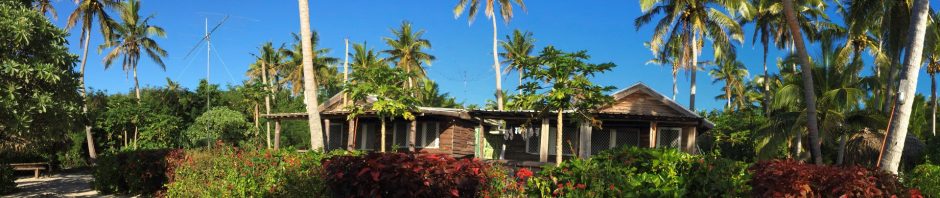
After loading, we pulled away from shore and headed out of the bay towards the ocean. The trip had been timed for the mornings when it typically was calmer seas that time of year, and we made good time, arriving at Flinders Island about 90 minutes later. Jonas once more pulled up on the beach and we were met by Peter and Nong, who helped unload and deliver our gear to our home for the next 7 days with a front-end loader. They made us feel very welcome and supplied us with all the facilities we could possibly want. It really was a remote island paradise.
SETTING UP THE STATION
After a quick tour of the homestead and facilities (including a vehicle for us to use to get around the island with) we quickly laid out where all of the stations would be located and started planning the antennas. Everyone pitched in, with the first order of business to erect a temporary linked dipole to see if we had any interference problems due to the solar power system. Alas, 40m was badly impacted, with birdies spaced every 5 kHz. There was a little impact on 80m as well, however for the most part, the higher bands were unaffected. We then sampled a couple of other locations and determined that it was less of a problem further away. Fortunately, we had brought long 100m coax runs with us, and so we set about building the 40m vertical ~ 100m away from the homestead and the 160-6m link dipole ~120m the other direction. It didn’t solve it, but it at least made it workable.

The team then split into several groups as we worked to get the HF Hexbeam and the VHF/UHF antennas in the air before sunset. Attention then turned to the stations themselves. Due to concerns with the capacity of the house solar power system, we limited our stations mostly to 100W, although one linear did make the trip. The gear used included 2x Elecraft K3 stations with Microham Keyer II interfaces and AirSpy HF+ SDR panadaptors. In addition, we had a KPA500 linear on one of the K3’s, with the rest of the stations used 2x Icom IC-7300 transceivers on HF, an Icom IC9700 on VHF/UHF and an Icom IC910 for the satellites. To help with inter-station isolation on HF, we also used a full set of W3NQN Filters for all bands.


HF ON AIR FROM VK5FIL
By nightfall, we had three stations ready to go, with the first call being a contact between Paul VK5PAS and his wife Marija VK5MAZ on 40m back in Adelaide.
We then settled down to our first evening meal together, expertly planned and prepared by Andrew and Ivan. It must be said that they fed us well during the trip, having taken the lead on planning the menu for the week and sourcing all of our food.

On Day 2, after a hearty egg and bacon breakfast, the team split into two groups. Some hit the radios while the others set out to finish installing the rest of the antennas (including the CrankIR multiband vertical loaned to the team by Steve VK5SFA). By lunchtime everything was complete and VK5FIL was fully operational.


Over the next few days, the team then did our best to exploit not only the local conditions on 160-40m but also the international DX on 40m and up to 10m. We in particular paid attention to 17m which proved an excellent band into Europe and were surprised at how well 15m long path also worked in the afternoons. Normally, 15m appears fairly quiet but we quickly discovered that if you call CQ they will come! One of the most memorable SSB pileups in fact came from the 15m band on that path. Activity on 10m was also particularly lucrative during the daylight hours
We also quickly found that operating simplex (single frequency) was very difficult given the number of callers we were facing. The team quickly got into the swing of split mode operation, where the wanted DX station (us) calls on one frequency and everyone else replies on another, typically “Up 5” or up 5kHz from us, or during peak times “Up 5 to 10 kHz” as we tried to spread the callers out enough that we could pick out a callsign to respond too! It did become difficult at times when there were people who would like to chat, and yet we had hundreds of stations trying to call us. To those who we were unable to say more than a few words, our apologies. We were only on the island for a very short time and our goal was to provide a contact with as many people as possible from that location. Given the rare nature of IOTA and WWFF entities we were operating from, we were never short of stations calling us.
VHF/UHF ACTIVITY – Tropospheric and TEP fun
One of the activities that Ivan VK5HS was particularly passionate about was to activate 6m. We were all a bit unsure how successful this would be thinking it was a bit late in the 6m DX season, but we followed the adage, if you never try you never know! It didn’t take long to prove the doubters wrong either! By the end of our first day, we were rewarded with an ionospheric Trans-Equatorial-Path (TEP) opening to Japan on 6m! The grin on Ivan’s face was never wider. Later in the trip he was able to catch several more openings on 6m, including during an opening during the closing hours of operation when he contacted several avid Japanese VHF IOTA hunters on 6m, using nothing more than a link dipole. It just goes to show that if you make the effort, you will be rewarded.


6m wasn’t the only band we brought equipment for, however. Ivan was also keen to try 2m, 70cm and 23cm. Despite being over 160km from the nearest amateur station, the plan was to try some VHF/UHF from the island. Again, Ivan’s efforts were rewarded with contacts to several stations in Adelaide 400km away, including VK5FO, VK5SFA, VK5RR and VK5HMV on 2m plus VK5FO, VK5RR and VK5HMV on 70cm. It certainly made the effort to setup the VHF/UHF station worthwhile for this expedition.
FLINDERS ISLAND VIA SATELLITE
The other unique activity attempted by the expedition was led by Adam, VK2YK/VK5GA. Using a Sartrac Mk3 Satellite tracking system (designed by Joe VK3YSP), he operated VK5FIL via 4 different satellites, including SO-50 and the ISS on 2m/70cm FM, RS-44 on SSB via its linear transponder and Greencube IO-117 via its digital store and forward repeater. Using either an arrow dual band 2m/70cm antenna or a dedicated 10 element 70cm Yagi (for Greencube) Adam managed 138 QSOs with 11 different countries in 4 continents.


The key to the success was the Greencube satellite which, with an orbital height of 10,000 km, supported QSOs into Africa, the Middle East, Japan, China, Indonesia, Australia, New Zealand and Argentina. The most difficult QSO was to LU5FF, as the mutual coverage window for that path was only 2 minutes wide. Adam was absolutely chuffed when they achieved contact on the second to last day of the expedition.
WWFF PORTABLE OPS AROUND THE ISLAND
As one of the key goals of the expedition the team activated each of the World-WideFlora and Fauna (WWFF) program parks on the island in turn. With access to a 4WD vehicle and a map, and spurred on by Paul VK5PAS, most of the team members headed off to various points around the island to set up and operate their battery powered portable stations. The team had a choice of activating VKFF-1717, the Investigator Marine Park, or VKFF-4307, Heritage Agreement HA1003, as well as activating VKFF-0175, the Investigator Important Bird Area. Each day the team members went out in relays to activate each of these parks, getting to see some of the spectacular sights of Flinders Island on the way. Paul, VK5PAS, even managed to get in a little fishing on the side with the island’s owners and helped supply some of the ingredients for our end of trip feast on the Saturday night.


SPECIAL EVENT CALLSIGN ACTIVATION – VI60IOTA

Towards the end of the expedition, the team also switched callsigns for a few hours and activated the special event callsign VI60IOTA from the island. This call celebrates the 60th anniversary of the Islands on the Air (IOTA) program. Part of the activity for that program has been to attempt to activate it from as many islands as possible throughout 2024. It was great to have the chance to operate it from the SA Centre West Islands group (OC-261) while we were on Flinders Island.
JOURNEY’S END – THE TALLY
After 7 days, and with food running low, it finally was time to repack all of the gear and prepare for the ride back to the mainland. There were smiles all around as everyone had thoroughly enjoyed themselves, having visited an amazing place with a fantastic group of people. To cap of the trip, our island hosts (and in particular Nong), prepared an amazing Thai banquet on the final night for dinner before we made our final QSO on the air. There were smiles and contentment all round. It was clear we couldn’t have gathered a better team.
Despite this being a holiday style expedition, we still managed to achieve quite a presence on the bands. In total, the team made 8427 QSOs as VK5FIL, 5102 of those were unique callsigns. We managed to have the station on air for a total of 96 hours and managed to work 119 DXCC countries in 7 continents at a rate of nearly 100 QSOs per hour. Activity was undertaken on SSB, CW and FT8 on HF, with over 1000 of the QSOs being made in CW. The feedback we were receiving from around the world from both the IOTA and WWFF communities was fantastic as well. It certainly made the effort to get to Flinders Island worthwhile.
In addition, the portable WWFF activations netted another 785 QSOs across the week plus we made 185 QSOs with VI60IOTA.

Team members – L-R VK5HS, VK5LA, VK5GA, VK5GR, VK5PAS, VK5FR
CONCLUSION
Overall, the project was a roaring success and far exceeded our expectations. Many thanks must be given to Jonas and Pepita who helped with our logistics plannings to get onto the island, and to Peter and Nong for their support of our group once on Flinders Island. It is a truly special place, and the fact that the family has opened the Eyrewolf Homestead as a holiday destination is a once in a lifetime opportunity. A huge thank you also to all our families who allowed us to take a week of to “go and play radio on a remote island” and most of all thanks must go to the team who came together and worked as one on the project. It was a fantastic group of people to be with and hopefully we can find new projects together for everyone to join in with in the future.
Finally, we must say thank you to everyone on air who took the time to call us and put VK5FIL in your logs. That is, after all, why we undertake these expeditions.
73 from the team